
Analysis of OceanLotus Organization’s Targeted Phishing Attacks Against Key Targets in China
The original report is in Chinese, and this version is an AI-translated edition.


1.Summary
Since the second half of 2025, Antiy CERT has continuously detected that the OceanLotus APT group is suspected of continuing to distribute phishing packages containing mirror image files via spear-phishing emails to core staff of key Chinese institutions. Most victims belong to departments and organizations related to national defense, politics, diplomacy, and think tanks.
Attackers initially contact targets through highly deceptive phishing emails, using current hot topics like the “15th Five-Year Plan” as phishing themes. The attachment contains image files with IMG file extensions. On Windows systems, these image files can be directly double-clicked to mount as virtual drives for user access. However, attackers exploit this convenience by embedding malicious files disguised as legitimate ones within the images. By leveraging users ‘habitual double-click behavior, they bypass security scans and execute malicious files through social engineering tactics. Current attack patterns reveal techniques such as inducing clicks on LINK files to trigger MST conversion, and altering legitimate software installations to covertly execute memory-based RUST remote control payloads. This remote control payload is the RUST remote control malware long used by the OceanLotus organization. The attack processes closely resemble the OceanLotus organization’s 2025 attack activities, with only minor variations in covert execution methods like MST conversion and DLL hijacking techniques.
The characteristics of related activities are summarized in the table below:
Table 1-1 Characteristics of Attack Activities
| Attack time | Active since the second half of 2025 |
| Targets | Departments and institutions in China related to national defense, politics, diplomacy, think tanks, and other fields |
| Event Overview | OceanLotus organization conducts phishing attacks targeting key targets in China |
| Attack intent | Spying and stealing secrets |
| Organization source | Vietnam |
| Bait type | IMG image, LNK shortcut |
| Attack method | DLL hijacking, MST application conversion |
| Development language | RUST language, C++ |
2.Attack Analysis
2.1 Attack Email Analysis
On October 30, 2025, the attacker, posing as the Defense Mobilization Office of the People’s Government of ** Province under a false identity, sent a spear-phishing email to the target through a self-registered NetEase email account ***2022@163.com. The content of the email was an announcement regarding suggestions for the “15th Five-Year Plan” for the development of people’s air defense in ** Province, and it prompted the target to view the attached file.
Table 2-1 Spear phishing email label
| Sender email | ***2022@163.com |
| Sending time | 30 October, 2025 15:42 (Thursday) |
| Email subject | Announcement on Soliciting Suggestions for the “15th Five-Year Plan for Civil Air Defense Construction and Development in ** Province” |
| Email content | The 15th Five-Year Plan period marks a significant beginning for China’s comprehensive efforts to build a modern socialist country, as well as a crucial five-year phase for achieving high-quality and leapfrog development in civil air defense construction. At this new historical starting point, scientifically planning the civil air defense development during the province’s 15th Five-Year Plan period holds profound significance. We cordially invite all civil air defense system staff and professionals across the province, as well as members of the public, to submit suggestions and recommendations regarding civil air defense development during the 15th Five-Year Plan period through various channels including telephone, fax, and email. Proposals may take diverse forms—systematic articles addressing specific themes, detailed perspectives on particular aspects, or even concise one-sentence recommendations. We will carefully review and compile these inputs, incorporating valuable suggestions into the 15th Five-Year Plan framework. Provincial Civil Air Defense Office November 2025 |
| Attachment file name | “15th Five-Year Plan for Civil Air Defense Construction and Development in the ** Province.zip” |
| Attachment file hash | fdfd9a180f5f7ce9d9f825db59**** |
The email content is as follows:
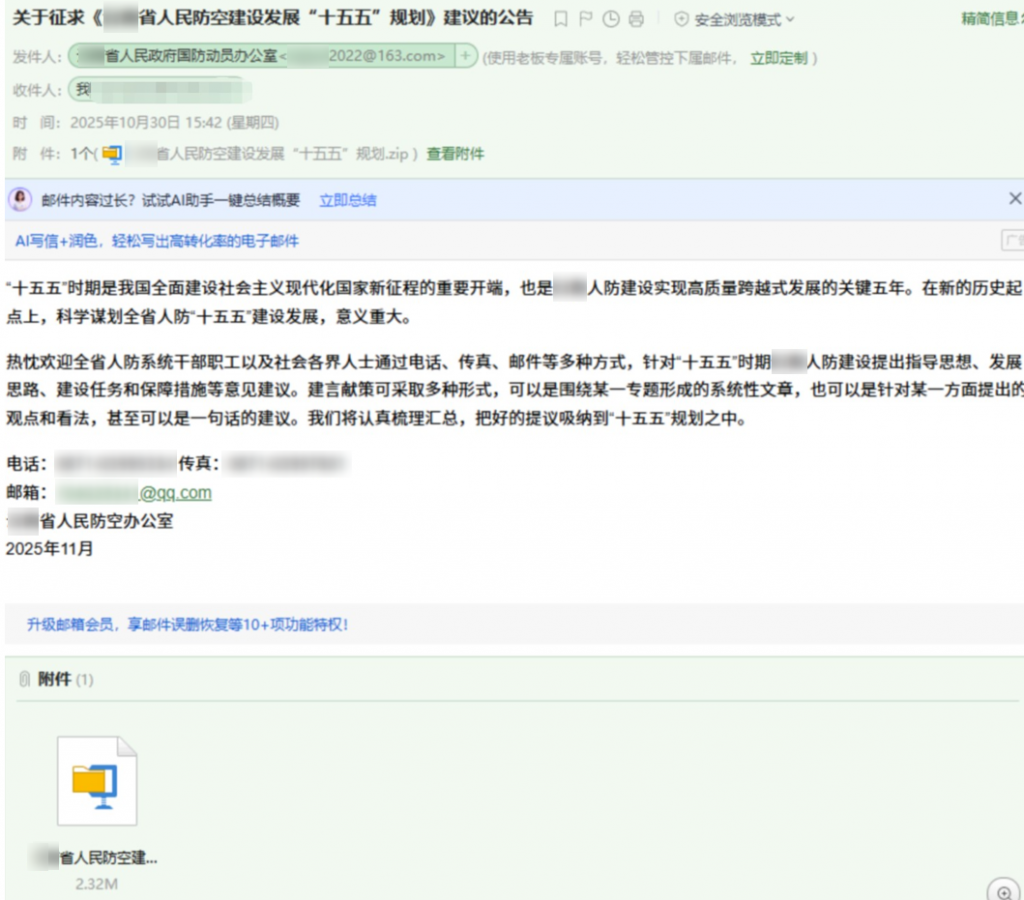
Figure 2-1 Spear phishing mail content
The email attachment is a ZIP file containing one IMG image file:
Table 2*2 Email attachment labels
| Virus name | Trojan/ZIP.Generic |
| Original file name | “15th Five-Year Plan for Civil Air Defense Construction and Development in the ** Province.zip” |
| MD5 | fdfd9a180f5f7ce9d9f825db5956*** |
| File size | 2.26 MB (2,374,322 bytes) |
| File format | Archive/Phil_Katz.ZIP |
| Last modification time | 2025:10:29 04:06:42 UTC+8 |
| File content | *15th Five-Year Plan for Civil Air Defense Construction and Development in the ** Province* *Extra-long space*.img |

Figure 2-2 Email attachment content
2.2 Attack Flow Analysis
Taking the latest bait mirror image as an example, the attack process of the attachment is analyzed as follows:
Table 2-3 Bait Mirror Sample Labeling
| Virus name | Trojan/IMG.Generic |
| Original file name | 2025-573 “Contemporary Middle Eastern State Governance Research”.img |
| MD5 | 3b87ccc7d0bd4b46b6b164d8d5*** |
| File size | 3.01 MB (3,164,160 bytes) |
| File format | Archive/ISO9660.ISO[:ISO image] |
| Last modification time | 2026:01:12 15:10:02 UTC+8 |
| File content | Contemporary Middle Eastern State Governance Research.docx.lnk ms3276.exe iexzY Download documents from 360 |
The initial bait sample is an IMG image wrapper file containing a shortcut and three hidden files.

Figure 2-3 Bait mirror image content
The file ms3276.exe is Microsoft’s official MSI executable (msiexec.exe), while iexzY is a malicious MST application conversion file created by attackers. The’ 360 Download Document ‘contains AnyViz’s legitimate MSI software installation package, which functions as a universal cloud adapter capable of converting any device into an IoT gateway.
The attacker tricked the victim into clicking the shortcut to the file “Contemporary Middle Eastern State Governance Research.docx.lnk”, which executed the command:
ms3276.exe /i 360下载文档 TRANSFORMS=iexzY ALLUSERS=2 MSIINSTALLPERUSER=1 /qn
/qn denotes silent installation without interface prompts, while iexzY refers to the MST conversion file that modifies the content of the legitimate MSI file “360 Download Document”.
Subsequently, MST will make the following modifications during MSI installation:
1. Modify the inary table structure to add custom DLLs, including AnyViz.dll:

Figure 2-4 Modify location for converted files
2. Modify the CustomAction table structure to specify the exported functions CloudInit and CloudSecurity from AnyViz.dll, and configure the system to load AnyViz.dll directly from the Binary table during installation while executing the specified exported functions. After MSI installation completes, launch the CloudAdapter.exe program in the AnyViz software installation directory to prepare for subsequent DLL hijacking:

Figure 2-5 Modify location for converted files
3. Modify the Directory table structure by adding an AnyVizFolder pointing to LocalAppDataFolder\AnyViz, specifying the MSI installation directory location. Combine this with the MSIINSTALLPERUSER=1 parameter in the installation command to enforce installation in “Current User Mode”, eliminating the need for administrator privileges during the installation process.

Figure 2-6 Modify location for converted files
4. Modify the Registry table structure by configuring the Run key to specify that CloudAdapter.exe starts at boot-up, ensuring persistence.

Figure 2-7 Modify location for converted files
5. Modify the InstallExecuteSequence table structure by setting CloudInit and CloudSecurity to NOT REMOVE, indicating these functions are executed only during installation or repair processes and not during uninstallation.

Figure 2-8 Modify location for converted files
The aforementioned modifications enable covert implantation of malicious DLL (AnyViz.dll) during MSI installation, execution of specified export functions (CloudInit and CloudSecurity), and persistence preparation for subsequent DLL hijacking.
Table 2-4 Sample Labels
| Virus name | Trojan/Win32.Generic |
| Original file name | AnyViz.dll |
| MD5 | 32deb724be2b33f8d5059980d7d6*** |
| Processor architecture | AMD64 |
| File size | 1.64 MB (1,730,048 bytes) |
| File format | BinExecute/Microsoft.DLL[:X64] |
| Time stamp | 2026-01-03 03:09:30 UTC+8 |
| Compiler language | Microsoft Visual C++ |
| Shell type | none |
The malicious DLL export function CloudInit extracts its own data, saves it as a Word document, and opens it:
%USERPROFILE%\\Documents\\2025-573《当代中东国家治理研究》_附件.docx
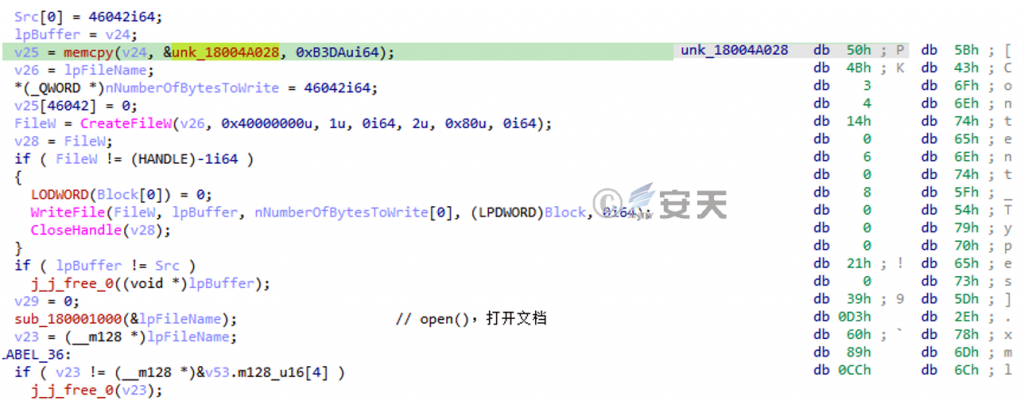
Figure 2-9 Open masked document
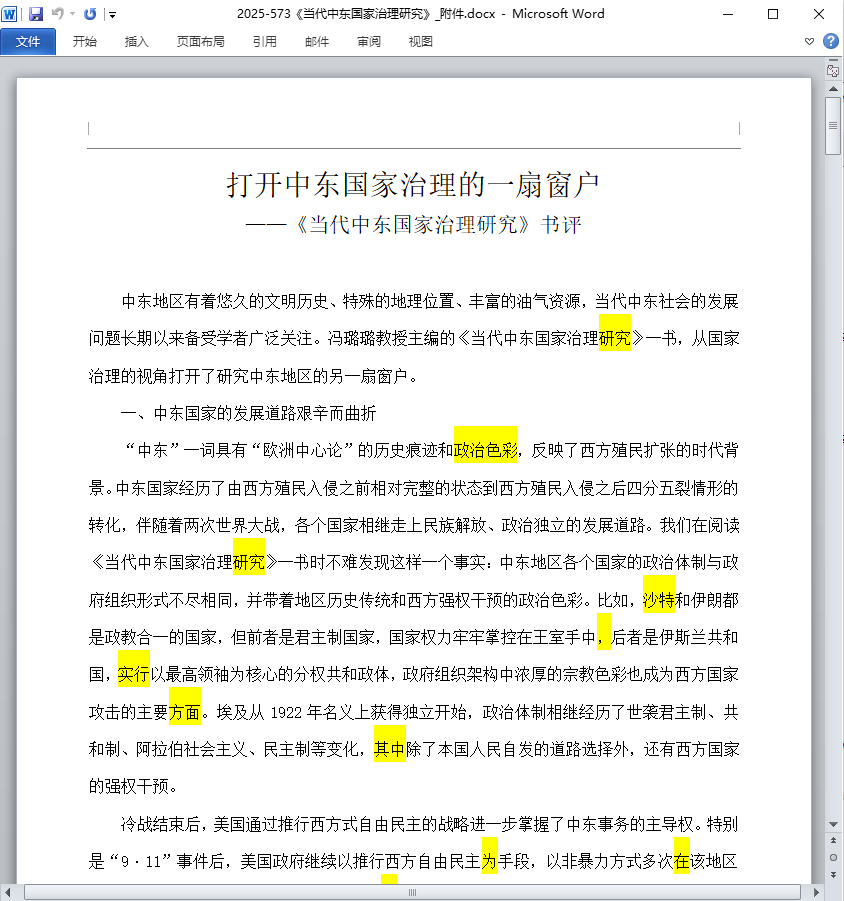
Figure 2-10 Conceal the document content
The malicious DLL export function CloudSecurity extracts its hard-coded data and releases files to the following directory:
%localappdata%\\AnyViz\\*
Uninstall the Trojan program file ark.x64.dll:
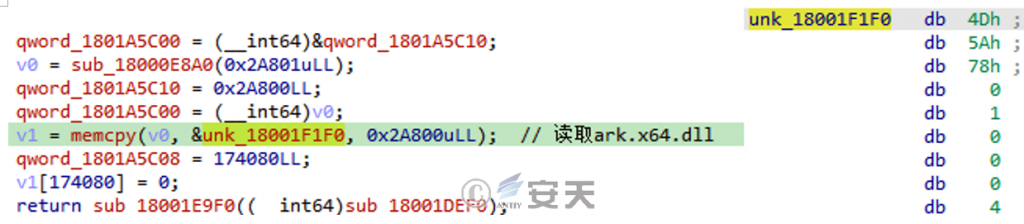
Figure 2-11 Releases Trojan Program
Release the Shellcode payload file bdzsfx.x64.sfx:
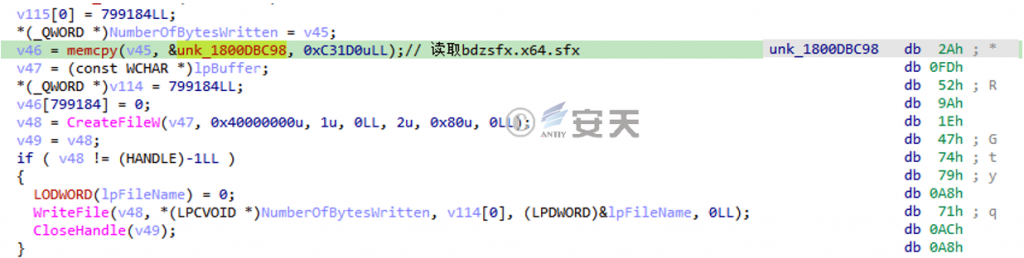
Figure 2-12 Release load file
Release the legitimate program file CloudAdapter.exe:
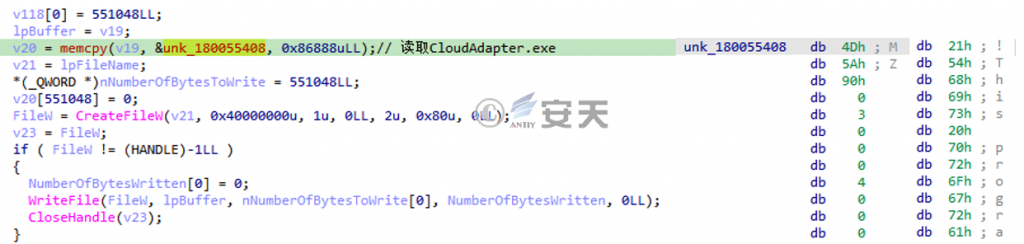
Figure 2-13 Release of white program
CloudAdapter.exe is the main program of the renowned decompression software Bandizip, which by default invokes the ark.x64.dll component in the same directory. However, this component has been hijacked by the Trojan program file ark.x64.dll, employing a white-plus-black tactic to evade antivirus detection.
Table 2-5 Sample Labels
| Virus name | Trojan/Win32.Generic |
| Original file name | ark.x64.dll |
| MD5 | add71189907a17cfc7e57d89c65b*** |
| Processor architecture | AMD64 |
| File size | 170 KB (174,080 bytes) |
| File format | BinExecute/Microsoft.DLL[:X64] |
| Time stamp | 2026-01-06 18:08:48 UTC+8 |
| Compiler language | Microsoft Visual C++ |
| Shell type | none |
The Trojan program ark.x64.dll primarily functions through its exported CreateArk function, with operations divided into two steps:
Reverse analysis methods. Check the debugger, virtual machine, or sandbox, and exit the process directly if necessary.
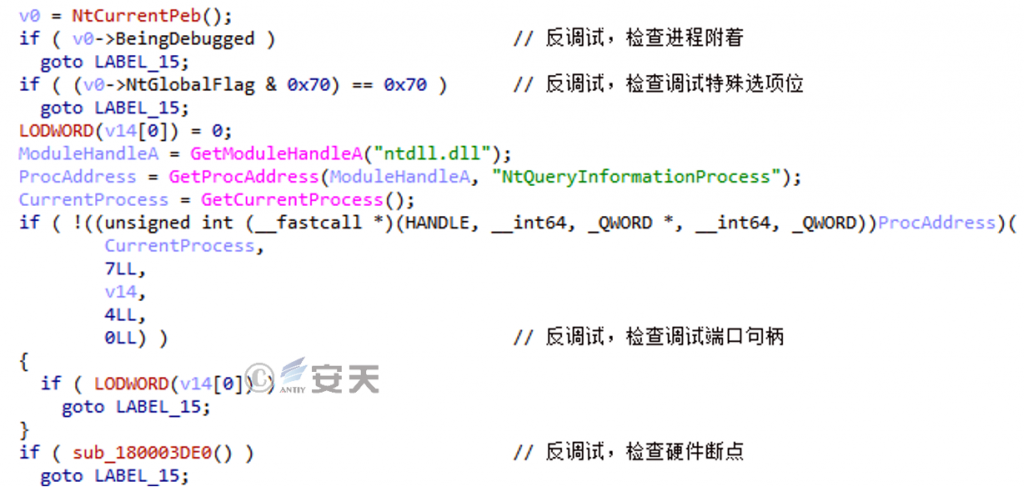
Figure 2-14 Check if the system is in debug mode
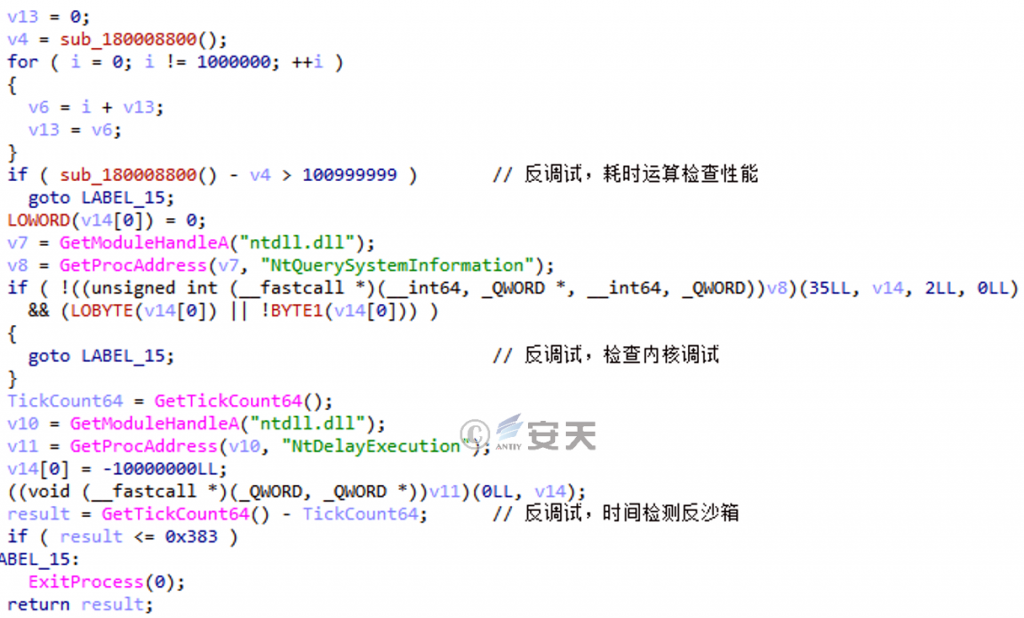
Figure 2-15 Check if the system is in a virtual environment
Decrypt the execution payload. First, read the Shellcode payload file bdzsfx.x64.sfx from the same directory:

Figure 2-16 Reading the payload file content
The payload file is then decrypted to extract the effective Shellcode byte stream. By parsing the kernel32 export table, the VirtualAlloc and VirtualProtect function addresses are obtained. A segment of executable memory is allocated, and the Shellcode is written and executed.

Figure 2-17 Shellcode with decrypted memory execution applied
This Shellcode employs the same RUST malware as routinely used by the Sea Lotus organization in their 2025 attack campaigns. Fully Shellcode-embedded, it enables remote command execution, file theft, file download, file execution, and remote code execution. The backdoor link to the C2 address is: http://45.126.***.***/portals/nationalfrontend/expedite/extensible/dynamic.
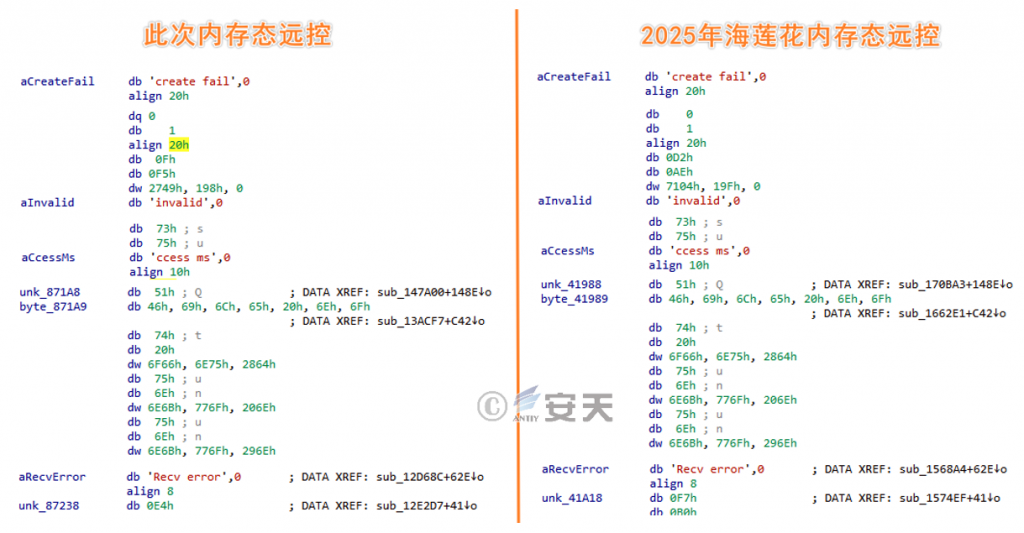
Figure 2-18 RUST TEMA load versus previous homologous data
3.Extension Line Analysis
Through code analysis and lineage tracing, we identified the following recent attack samples employing similar tactics by the Sea Lotus organization:
Table 3-1 Homologous Sample Cases
| Primary decoy | Hide Document | ark.x64.dll | C2 address |
| 62c2010daaecfc709c17e7cb2db5*** | “15th Five-Year Plan for Civil Air Defense Construction and Development in the Province.docx” | 7d71f1a7dd0ec5aab1df8b16cba7*** | http://139.180. ***.***:80/latest-news/post/9034/519807/213894 |
| a5dc80d5c8e34ec68367964e42e2*** | dzfp_25127000000535412589_Peking*** Holding Co., Ltd.pdf | 1fe8653be28790798015410835dd*** | http://141.11. ***.***/sourcedb/cn/gb/yjy1/zlyswzz/files/resource/121085793/tyfls_674667/index_5.shtml |
| ca75e2edfcf352e74630065d5832*** | dzfp_25127000000756822462_*** Group Co., Ltd. Beijing Branch.pdf | e01fd19ec98dd8cf8a98267ecec7*** | http://83.147. ***.***/info/plot/expansion/activity/meeting |
| 22bd9b807c9c60d752b5d1eb3abe*** | 2025-573 “Security Enhancement of Technology Alliances and the U.S. Alliance Strategic Framework”.docx | 034b4a14b0bbe9ec2b3ebe4d174c*** | http://45.126. ***.***/portals/nationalfrontend/expedite/extensible/dynamic |
| 91bee26f132d15fd49e1dd274e5a*** | Hotel Booking Receipt.pdf | 0fc6bc76122548d11e68c052c2b1*** | http://139.180. ***.***/latest-news/post/9034/519807/213894 |
| fdfd9a180f5f7ce9d9f825db5956*** | “15th Five-Year Plan for Civil Air Defense Construction and Development in the Province.docx” | 7bd21fb209bdced74ed4646f695*** | http://172.235. ***.***:8000/static/rapture/nexus-blobstore-s3-prod.js |
4.Analysis of Offensive Tactics and Mapping of Threat Tactics Framework
Through sample analysis and examination of attack implementation dependencies, we can reconstruct the tactical process. The attackers employed social engineering techniques to craft phishing emails with deceptive content. Instead of using vulnerability exploitation as entry points, they leveraged the executable capabilities of LNK files through multiple methods—including application transformation installation, memory payload injection, and encryption/decryption—to bypass detection mechanisms and achieve remote control access. This series of attacks involved 16 technical points across 10 phases of the ATT&CK framework, with detailed behavioral descriptions presented in the table below:
Table 4-1 Technical Behavior Description of This Attack Activity
| ATT&CK stage | Concrete behavior | Explanatory note |
| Reconnoitre | Collect victim identity information | Collect victim network account information and job details |
| Collect victim organization information | Collect information about the victim’s employer | |
| Resource development | Access to infrastructure | Implement remote control C2 and other functions |
| development of faculty | Development and Production of Malicious Components | |
| Create account | Create an attack email sender account | |
| Initial access | phishing | Attackers distribute malicious attachments via spear-phishing emails. |
| Execution | Guide users to execute | Target link file for induction |
| Use command and script interpreters | Run the built-in command in the LNK file to start the process | |
| Persistence | Use automatic startup to execute boot or login | Create a registry startup item to enable persistence |
| Defense evasion | Execution flow hijacking | Hijack legitimate software or the installation process |
| Disable debugger | Identify debuggers to avoid | |
| Anti-tampering/decoding files or information | Decrypt payload data file | |
| Find | Disable debugger | Detection of debugger avoidance |
| Command and control | Apply application layer protocols | The remote control utilizes the application layer HTTP protocol. |
| Data leakage | Use C2 channel for backhaul | The remote control utilizes a fixed C2 channel for data backhaul. |
| influence | manipulation data | Attackers can manipulate the data content of controlled machines. |
The threat behavior techniques involved are mapped to the ATT&CK framework as shown in the figure below:
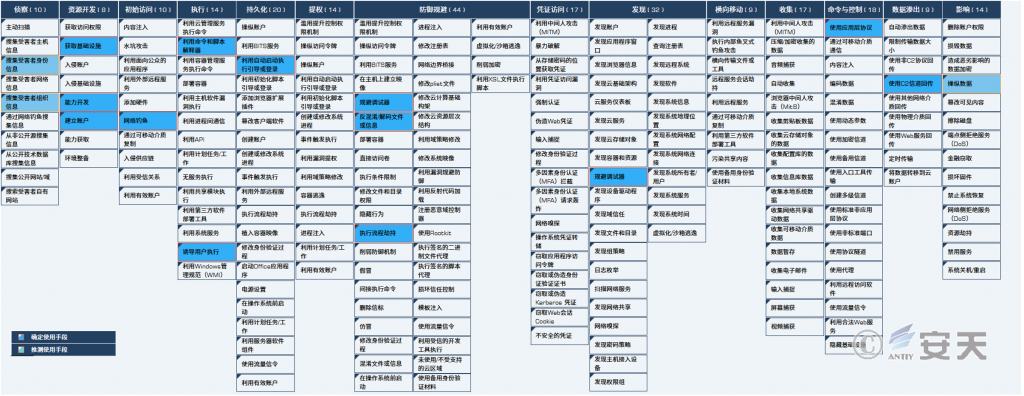
Figure 4-1 ATT&CK mapping diagram corresponding to this attack campaign
5.Mapping Matrix of the full Life Cycle of Attack Payload Execution Entities and Key Capabilities of Security Products
Through comprehensive threat event analysis, we identified the attack process involving operational targets and actions throughout the attack payload execution lifecycle. This enables further evaluation of the critical capability mapping matrix that endpoint-deployed security software should possess, including antivirus engines and active defense capabilities. The key detection and defense capability points for this series of attack activities are described in the table below:
| Attack execution life cycle | Target | Movement | Threat detection engine Key competencies | Active defense capability Key competencies | |
| Pre-set and Deployment | Deployment | Spear phishing email | The attacker sends spear-phishing emails with themes such as the 15th Five-Year Plan. | 1. Email metadata extraction 2. Email sender detection 3. Email body content detection (social worker script) | 1. (Phishing Email Protection) Analyzes email protocols and extracts source data, including body text, attachment filenames, attachments, sender, subject, and other email object data sources 2. (Phishing Email Protection) Set sensitive word alert rules for email content and subject lines |
| Attachment enclosure: IMG acoustic image | Recipient receives email attachments | 1. Attachment IMG image format recognition 2. Decomposition of derivative files from IMG image package attachments 3. Recursion-based detection of derivative IMG file decomposition | 1. (Phishing Email Protection) Extract email attachments, detect via delivery engine, and block emails with malicious attachments | ||
| Download and execution | Execution | LNK file in IMG image | The victim opened the LNK file to execute the command, initiating MST conversion. | 1.LNK format recognition 2.LNK Metadata Extraction 3. Detecting embedded execution of specific silent installation commands in LNK | 1 (Process Defense) Monitor process startup parameters and set alarm notification rules |
| Persistence | Convert file iexzY | Create a registry startup item for CloudAdapter.exe | not applicable | 1. (Registry Defense) Monitor registry startup items, extract process names and startup content added to the registry, deliver to the detection engine, intercept malicious startup items, and delete them | |
| For optimal utilization | Process effectiveness | Convert file iexzY | Tamper with the structure of legitimate software installation packages and insert malicious components AnyViz.dll | not applicable | not applicable |
| Malicious component AnyViz.dll | Extract your own data: 1. Save as a Word document and open it 2. Release the legitimate white program file CloudAdapter.exe 3. Release the Trojan program file ark.x64.dll 4. Execute the Shellcode payload file bdzsfx.x64.sfx | 1. PE format recognition 2. Compiler recognition (Visual C++) 3. Analyze import and export tables 4. Detection of extracted proprietary import/export sequences | 1. (File Defense) Monitor all file creation, detect via delivery engine, and delete threat files | ||
| Trojan program ark.x64.dll | The DLL hijacks the legitimate program file CloudAdapter.exe, decrypts it, and executes the Shellcode payload file bdzsfx.x64.sfx. | 1. PE format and compiler type recognition 2. Malicious instruction detection at the actual PE entry point | 1. (File Defense) Monitor all file creation, detect via delivery engine, and delete threat files | ||
| Shellcode file bdzsfx.x64.sfx | After decryption, it is expanded in memory as RUST remote control. | 1. Unformatted file (Shellcode file) recognition 2. Execute embedded specific Shellcode instructions for detection | 1. (Host firewall) monitors application requests to C2 server data packets, extracts access IP addresses, domain names, and URLs, and uses the delivery engine to detect and block threat-based C2 server access requests. | ||
| Objective effectiveness | RUST Remote Control | Supports remote command execution, file theft, file download, file execution, and remote code execution. | Remote control return link C2 address detection | 1. (Host firewall) monitors application requests to C2 server data packets, extracts access IP addresses, domain names, and URLs, and uses the delivery engine to detect and block threat-based C2 server access requests. | |
6.Brief Summary
Antiy CERT identified this as a series of phishing attacks conducted by the OceanLotus APT group originating from Vietnam. The attackers deployed multiple malicious payloads via email attachments, inducing targets to execute their contents to trigger attack vectors including MST application transformation and DLL hijacking techniques. The attacks ultimately succeeded in deploying OceanLotus’s RUST remote control malware in memory state. Most affected organizations were affiliated with Chinese entities involved in national defense, political affairs, diplomacy, and think tank sectors.
The attacker did not use traditional ZIP or other packaging formats for the delivery but adopted the CD image method instead. This was because Windows systems defaultly can parse and load the image files, but some security software lack the ability to parse and detect the image format files, resulting in the inability to detect malicious code and increasing the probability of successful attack delivery. The Anti-Virus Engine of Antiy AVL SDK has deep preprocessing and heuristic detection capabilities for common formats. The Antiy Zhiya EDR, based on the active defense mechanism, can achieve real-time interception and control of attack behaviors. When combined, they form a closed-loop protection capability from the stages of delivery, execution, persistence to payload and effect, which can effectively counter similar attack tactics.